Monday, 13 March 2023

Root any Android device and Make your own hacking device.

 Root any Android device and Make your own hacking device.

 Enabling Superuser access on an Android device involves several steps, and the process can vary slightly depending on the device and Android version you are using. Here are the general steps to enable Superuser access:

  1. Root your Android device: In order to enable Superuser access, you must first root your Android device. Rooting involves unlocking the device's bootloader and installing a custom recovery that allows you to flash custom ROMs and gain access to the device's system files. The process for rooting your device can vary depending on the device and Android version you are using, and there are many online resources that can provide detailed instructions on how to root your device.

  2. Install a Superuser app: Once you have rooted your device, you will need to install a Superuser app. This app will manage Superuser access and grant or deny permission requests from other apps. There are many Superuser apps available in the Google Play Store, including SuperSU and Magisk.

  3. Grant Superuser access: After installing a Superuser app, you will need to grant Superuser access to individual apps that request it. When an app requests Superuser access, the Superuser app will display a prompt asking you to grant or deny permission. You can choose to grant permission permanently or just for the current session.

  4. Manage Superuser access: It's important to manage Superuser access carefully to ensure that your device remains secure. Be sure to only grant Superuser access to apps that you trust, and revoke access for apps that no longer need it. You should also be careful when granting permanent access, as this can give an app unrestricted access to your device's system files.

In summary, enabling Superuser access on an Android device involves rooting the device, installing a Superuser app, and carefully managing access to ensure that your device remains secure. The process can be complex and should only be attempted by advanced users who understand the risks involved

Earn online money with the help of GPT chat 100% free free no hidden charges.

  1. I'mWrite a clear and concise channel description that explains what your channel is about, what types of videos you will be creating, and what viewers can expect to see on your channel.

  2. Create high-quality videos that provide value to your viewers. Make sure that your videos are well-produced, engaging, and informative. Use relevant keywords in your video titles, descriptions, and tags to help viewers find your content.

  3. Use keyword-rich titles for your videos that accurately describe the content. Avoid using clickbait titles that are misleading or unrelated to the video content.

  4. Use tags that are relevant to your video content and niche. Use a mix of long-tail and short-tail keywords to help your videos rank higher in search results.

  5. Optimize your video descriptions by including relevant keywords and phrases. Use your description to provide more details about your video content, as well as links to your website or social media profiles.

  6. Use annotations and end screens to promote other videos on your channel and encourage viewers to subscribe. This will help to increase engagement and boost your channel's SEO.

  7. Regularly upload new content to your channel to keep viewers engaged and to help improve your channel's ranking in search results.

In summary, creating an SEO-friendly YouTube channel involves creating high-quality content, optimizing your video titles, descriptions, and tags, and using annotations and end screens to promote your channel. By following these steps, you can improve your channel's visibility and attract more viewers to your videos.

Thursday, 9 March 2023

Hack Any Device by Kali Linux Commands.

         Hacking Commands of Kali Linux.


Kali Linux is a popular Linux distribution used for penetration testing and ethical hacking. In this article, we'll provide a list of some common commands you can use in the Kali Linux terminal.

  1. pwd: Shows the current working directory.
  2. cd: Changes the current directory.
  3. ls: Lists the files and directories in the current directory.
  4. mkdir: Creates a new directory.
  5. rmdir: Deletes an empty directory.
  6. rm: Deletes a file or directory.
  7. cp: Copies a file or directory.
  8. mv: Moves a file or directory.
  9. cat: Displays the contents of a file.
  10. nano: Opens a text editor.
  11. vi or vim: Opens a text editor.
  12. tar: Compresses or extracts files and directories.
  13. gzip: Compresses or decompresses files.
  14. ping: Tests network connectivity to a specific host.
  15. ifconfig: Displays network interface configuration information.
  16. netstat: Shows network statistics.
  17. route: Displays or modifies the routing table.
  18. ssh: Connects to a remote host using the SSH protocol.
  19. scp: Copies files to and from a remote host using the SSH protocol.
  20. wget: Downloads files from the Internet.

These are just some of the most common commands used in Kali Linux. There are many more commands available, and you can find them by using the built-in help system or by searching online for Kali Linux command references.

Note: Kali Linux is a powerful tool and should be used with caution and only for legal and ethical purposes. Misuse of Kali Linux can lead to serious legal and ethical consequences.

Quantum Computing: A Revolution in Computing Technology.

 Quantum Computing: A Revolution in Computing Technology

Quantum computing is a cutting-edge technology that promises to revolutionize the computing industry. With the ability to perform complex computations at unprecedented speeds, quantum computers are expected to provide breakthroughs in a range of fields, including cryptography, artificial intelligence, and drug discovery.

What is Quantum Computing?

Quantum computing is based on the principles of quantum mechanics, which describe the behavior of matter and energy at the atomic and subatomic level. Unlike classical computing, which relies on binary digits, or bits, to represent information as either a 0 or 1, quantum computing uses quantum bits, or qubits, which can exist in a superposition of two or more states. This allows quantum computers to perform calculations in parallel and potentially solve problems that are too complex for classical computers.

How Does Quantum Computing Work?

Quantum computers use a variety of techniques to manipulate and measure qubits, including laser pulses, magnetic fields, and electric fields. One of the most important techniques is quantum entanglement, which allows two or more qubits to become correlated in such a way that the state of one qubit depends on the state of the other.

Quantum computers use algorithms that are designed to take advantage of the unique properties of qubits. One of the most famous quantum algorithms is Shor's algorithm, which is used to factor large numbers and is expected to break the encryption algorithms that are currently used to secure online communications.


What are the Applications of Quantum Computing?

Quantum computing has the potential to revolutionize many fields, including:

  1. Cryptography: Quantum computers can break the encryption algorithms that are currently used to secure online communications, making them a threat to national security.

  2. Artificial Intelligence: Quantum computing can be used to develop more advanced machine learning algorithms that can process and analyze large amounts of data more quickly than classical computers.

  3. Drug Discovery: Quantum computing can be used to simulate the behavior of molecules and predict their properties, making it easier and faster to develop new drugs.

  4. Optimization: Quantum computing can be used to solve optimization problems, such as finding the shortest route between two points, more quickly than classical computers.

In conclusion, quantum computing is a revolutionary technology that has the potential to transform the computing industry. While quantum computers are still in the early stages of development, the progress that has been made so far suggests that we can expect significant breakthroughs in the near future. As the technology advances, we can look forward to a world where complex computations can be performed quickly and efficiently, leading to new discoveries and innovations that will benefit society as a whole.

Quantum computing is a type of computing that relies on quantum mechanics to perform complex computations. Unlike classical computing, which uses bits to represent information as either a 0 or 1, quantum computing uses quantum bits, or qubits, to represent information as a combination of 0 and 1 at the same time, known as superposition. This allows quantum computers to process information in a way that is significantly faster and more powerful than classical computers.


Saturday, 15 May 2021

How to install a Linux desktop on your Android device

     How to install a Linux desktop on your Android device.


( New Method ) For Mobile => 

For Mobile => 


#1 => Open Termux and Type 

startkali


Step1.2 => sudo su

Step 1.3 => kali


press enter and than step 2

#2 => Type Below command

apt-get update && apt-cache search kali-linux


Step #3 => Type 


apt-get install kali-linux-default


total 5 GB Internet is required


3 Things to Remember => 


Type yes for every option Installation will ask


Type 1 for everything option installation will ask


User Group to add Type => root 


If any Error occurred in Installation then =>


type, these below commands 1 by 1 


sudo su

kali

kill 30727

apt --fix-broken install

dpkg --configure -a

apt-get update

apt-get install kali-linux-default

INSTALL TERMUX APP FROM PLAYSTORE AND TYPE

apt update && apt upgrade

cd $HOME

curl -LO https://raw.githubusercontent.com/Hax4us/Nethunter-In-Termux/master/kalinethunter

chmod +x kalinethunter

./kalinethunter

startkali

apt-key adv --keyserver hkp://keys.gnupg.net --recv-keys 7D8D0BF6


and if it shows root@localhost => It means Kali is Installed, now day #14 


=================================================================================

For Laptop => Only for Laptop or Computer 


Step #1 => Install Utorrent & Download Kali Linux OVA File 

Utorrent Downloading Link => https://www.utorrent.com/

Kali Linux 32 Bit Downloading Link => https://images.offensive-security.com/virtual-images/kali-linux-2020.2a-vbox-i386.ova.torrent

Kali Linux 64 Bit Downloading Link => https://images.offensive-security.com/virtual-images/kali-linux-2020.2a-vbox-amd64.ova.torrent


Step #2 => Install Virtual Box & Extension Pack

Virtual Box 64 bit Downloading Link => https://download.virtualbox.org/virtualbox/6.1.10/VirtualBox-6.1.10-138449-Win.exe

Virtual Box Extension Pack 64 bit Downloading Link =>  https://download.virtualbox.org/virtualbox/6.1.10/Oracle_VM_VirtualBox_Extension_Pack-6.1.10.vbox-extpack

Virtual Box Macbook Downloading Link => https://download.virtualbox.org/virtualbox/6.1.10/VirtualBox-6.1.10-138449-OSX.dmg

Virtual Box 32 bit Downloading Link => https://download.virtualbox.org/virtualbox/5.2.42/VirtualBox-5.2.42-137960-Win.exe

Virtual Box Extension Pack 32 bit Downloading Link => https://download.virtualbox.org/virtualbox/5.2.42/Oracle_VM_VirtualBox_Extension_Pack-5.2.42.vbox-extpack


Step #3 => Open OVA file after installing Virtual Box 


Kali Linux ID and Password =>

username = kali

password = kali


Saturday, 25 May 2019

Check out Trepup. Sign up and we both get 1,000 free email credits

Check out Trepup. Sign up and we both get 1,000 free email credits: Invite and refer a friend to earn email credits on Trepup. Tell friends to sign up for Trepup using your invite code, and both you and your friend will earn 1,000 email credits.

Friday, 3 May 2019

Kali Linux on Android using Linux Deploy

 Kali NetHunter turns Android device into hacker Swiss Army knife

guide for kali linux

Free to download, ready to customize, NetHunter puts the power of a pen-tester's Linux desktop on a Nexus phone or tablet.
One of the tools we've leaned on heavily in some of our lab testing of software privacy and security is Kali Linux. The Debian-based operating system comes packaged with a collection of penetration testing and network monitoring tools curated and developed by the security training company Offensive Security. Today, the Kali developer team and Offensive Security released a new Kali project that runs on a Google Nexus device. Called NetHunter, the distribution provides much of the power of Kali with the addition of a browser-driven set of tools that can be used to launch attacks on wireless networks or on unattended computers via a USB connection.
NetHunter is still in its early stages, but it already includes the ability to have the Nexus device emulate a USB human interface device (HID) and launch keyboard attacks on PCs that can be used to automatically elevate privileges on a Windows PC and install a reverse-HTTP tunnel to a remote workstation. It also includes an implementation of the BadUSB man-in-the-middle attack, which can force a Windows PC to recognize the USB-connected phone as a network adapter and re-route all the PC’s traffic through it for monitoring purposes.
A demonstration of NetHunter's HID Keyboard attack on a Windows 8 computer.
In a phone interview with Ars, Offensive Security’s lead trainer and developer Mati Aharoni said that while NetHunter can be compiled to run on Android devices other than the Nexus family, “part of the reason we chose Nexus devices was because of the specific kernel sources we were able to get from Google. "The Nexus devices supported by NetHunter include the Nexus 5 ("hammerhead"), Nexus 7 (both 2012 and 2013 versions), and the Nexus 10 ("mantaray").
Features that exploit those sources—such as the low-level code for Wi-Fi and USB device connections—make some of NetHunter’s features possible. “Some of the features won’t work on other devices because they are kernel dependent,” Aharoni said. “For example, wireless network injection won’t work, and the keyboard and BadUSB attacks won’t work on other devices.”
While NetHunter uses the same platform as Pwnie Express’ PwnPad and PwnPhone—which are also based on the Kali Linux distribution—“as far as we’re concerned there’s very very little in common with Pwnie,” Aharoni said. “The big difference is that our project is open source for anyone to grab and modify. And it’s very simple for anyone to build custom images of the project” to meet their own needs, he said.
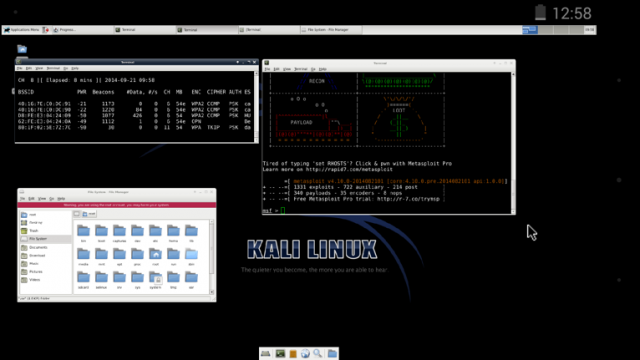
A full Kali Linux desktop running in a VNC viewer on NetHunter.
Enlarge / A full Kali Linux desktop running in a VNC viewer on NetHunter.
While many of the features of NetHunter are currently accessible through a Web interface driven by a local Apache server on the device, Aharoni said that the web interface “is just a means for a lazy sort of access to the tools. It’s a proof of concept that we set up—long term, a proper android app would be more suitable.” And for those who want it, NetHunter also allows for a full Kali Linux desktop to run in a VNC session on the device (though that may be more practical on a Nexus tablet than a Nexus phone) or access command-line tools from a terminal session. And that’s where much of the deeper power of NetHunter resides.

Root any Android device and Make your own hacking device.

 Root any Android device and Make your own hacking device.   Enabling Superuser access on an Android device involves several steps, and the ...